

If you are worried about losing your job due to the rise of Artificial Intelligence (AI) in various industries, including programming, analysis, and content requirements, this article can provide insights into the importance of human inputs and governance as a means of regulating AI and ensuring its effectiveness.
As technology continues to advance at a rapid pace, Artificial Intelligence (AI) has emerged as a game-changing innovation, providing unique opportunities. However, with this power comes great responsibility, and this is where the critical role of data governance in regulating AI becomes crucial.
Understanding the AI Landscape:
AI systems rely on the data they are trained on, and the quality and ethical standards of this data have a significant impact on how AI algorithms behave and make decisions. With AI applications becoming increasingly prevalent in various aspects of our lives, such as healthcare, finance, autonomous vehicles, and virtual assistants, it is crucial to prioritize ethical standards in AI development. Ethical AI must become an absolute priority to ensure that these systems benefit society in a positive way.
The Nexus Between Data Governance and Ethical AI:
- Data Quality Assurance:
Role of Data Governance: Establishing data quality standards, validation processes, and regular audits to ensure that AI systems are trained on accurate, unbiased, and reliable data.
- Bias Mitigation:
Role of Data Governance: It is important to have policies and procedures in place to identify and rectify biases in training data. Striving for fairness and impartiality in AI models is a crucial aspect of ethical AI deployment.
- Privacy Preservation:
Role of Data Governance: AI training must be transparent regarding data usage to maintain trust.
- Accountability and Transparency:
Role of Data Governance: Creating frameworks for transparent AI decision-making. Documenting data sources, algorithms, and decision criteria facilitates stakeholder comprehension and challenges to AI outcomes.
- Security Protocols:
Role of Data Governance: Developing secure AI training data and models to prevent unauthorized access, tampering, or exploitation and minimize adversarial attacks.
The Journey Toward Ethical AI Through Data Governance:
- Establishing Policies and Standards:
Creating clear policies and standards within the data governance framework that outline ethical guidelines for AI development, deployment, and ongoing monitoring.
- Cross-Functional Collaboration:
Fostering collaboration among data governance, data science, and legal teams can provide a more comprehensive understanding of the ethical implications of AI technologies.
- Continuous Monitoring and Auditing:
Continuous monitoring and auditing mechanisms should be implemented in the data governance structure to track the ethical performance of AI systems over time, including assessing data inputs and model outputs and promptly addressing issues.
- Ethical AI Training Programs:
Employee training programs should integrate ethical AI principles. All stakeholders, from data scientists to decision-makers, must understand AI’s ethical considerations.
Conclusion:
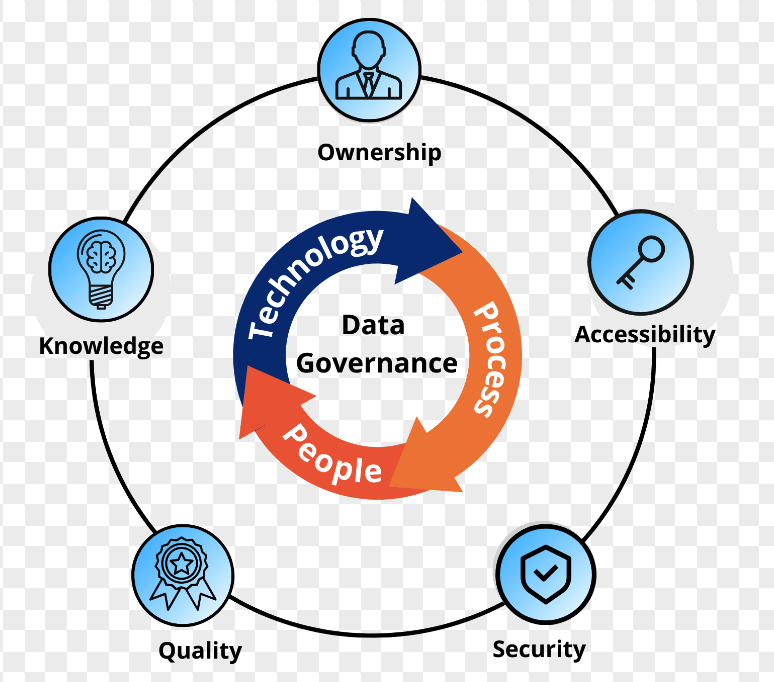
As artificial intelligence (AI) becomes increasingly integrated into our digital world, the role of data governance in regulating AI is not a choice, but an ethical obligation. By promoting transparency, fairness, and accountability, data governance serves as the moral compass that guides the responsible development and deployment of AI, ensuring a future where innovation and ethics coexist harmoniously. The journey towards ethical AI begins with adopting robust data governance practices—the guardians of an AI-powered world with integrity and trust as its fundamental values.